
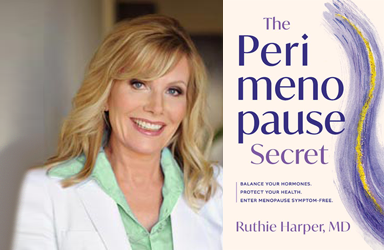
Coming Soon: Dr. Harper’s New Book “The Perimenopause Secret”
Preorder: THE PERIMENOPAUSE SECRET: Control Your Hormones, Protect Your Health, and Enter Menopause Symptom-Free
Every woman who lives into her fifties will pass through perimenopause. It is not a brief episode but a hormonal transition that can stretch five to fifteen years, and it arrives with a long list of possible symptoms: fatigue that sleep does not fix, hot flashes, night sweats, weight that settles in new places, brain fog, and mood shifts that seem to come from nowhere.
What makes it so disorienting is often the response women get when they finally ask for help. Instead of an evaluation of what their hormones are doing, they are told they are simply getting older, or that stress is to blame, or they leave with a prescription for an antidepressant.
Ruthie Harper, MD, has spent decades listening to those women, and she has written a book for them. THE PERIMENOPAUSE SECRET: Control Your Hormones, Protect Your Health, and Enter Menopause Symptom-Free arrives on March 16, 2027, in paperback at $18.99 (ISBN 9798896364962). (PREORDER YOUR COPY ON AMAZON NOW)
Why Perimenopause Is So Often Dismissed
The symptoms of this transition overlap with a dozen other explanations. Fatigue, low mood, and difficulty concentrating are easily blamed on a demanding job, young children, aging parents, or poor sleep, and often they are, without anyone checking further.
When the hormonal changes go unexamined, women manage symptoms one at a time rather than what is driving them. Years pass this way, with the transition treated as a mood or weight problem instead of the endocrine shift it is.
Dr. Ruthie Harper wrote this book for the woman who feels confused, unheard, or brushed aside. Her position is direct: perimenopause is a real and well-documented biological event, and no woman should be told to simply endure it.
A New Framework for Understanding Perimenopause
Perimenopause is usually described as the wind-down of the reproductive years, which makes it sound like a matter of fertility and nothing more. That framing leaves out what matters most over the following decades.
Drawing on emerging research and the principles of functional and precision medicine, Dr. Harper makes the case that this is a major biologic shift with consequences for cardiovascular health, bone density, metabolic function, and cognition. The choices a woman makes during these years echo forward into her sixties, seventies, and beyond.
The book is built around the real experiences of women in their thirties, forties, and early fifties, alongside the science. That combination gives readers both an explanation for what they are feeling and a practical plan for what to do about it.
Recognizing Perimenopause Before Periods Stop
One of the most persistent misunderstandings is that the transition has not begun until menstrual cycles have. Dr. Harper is clear on this point: symptoms frequently show up years before periods become irregular or stop, so waiting for a change in cycles means waiting through the very years when intervention helps most.
Hormones during this stage do not decline in a tidy downward line. They swing, sometimes dramatically, which explains why a woman can feel entirely like herself one month and unrecognizable the next.
The book includes symptom checklists and charts mapping the hormonal highs and lows of perimenopause, giving women concrete language to bring to an appointment.
What the WHI Study Got Wrong
Few pieces of research have shaped women’s medicine as heavily as the Women’s Health Initiative study of the early 2000s. Its findings, widely reported and widely misread, produced a generation of fear around hormone therapy that has never fully lifted.
Dr. Harper walks readers through what that study actually measured, where its design fell short, and how its conclusions came to be applied to women it was never built to describe. Many practicing physicians still carry those assumptions into the exam room today.
A woman who understands why that fear took hold is far better positioned to ask informed questions about her own options.
Why Timing Matters During Perimenopause
A common piece of advice is to wait until menopause is complete before considering hormone therapy. Dr. Harper argues that this delay costs women the window in which treatment does the most protective work.
Beginning Bioidentical Hormone Replacement Therapy during perimenopause, rather than years afterward, may help guard against what she calls the Fatal Four: heart disease, osteoporosis, diabetes, and dementia. These are the conditions that shape a woman’s health span, and their groundwork is laid during this transition.
Treatment during perimenopause is therefore preventive medicine, not symptom relief alone. The relief is real, but the long-term protection is the larger argument.
Hormone Testing and BHRT in Perimenopause
Testing is where many women get incomplete answers. Perimenopause is often reduced to a question of low estrogen, when a fuller picture requires looking at several hormones and understanding how they interact.
The book explains which hormones warrant testing, why the timing of a test can change the result, and how to read what comes back. Without that context, a single lab value is easily read as normal when it is not the whole story.
Dr. Harper also lays out how BHRT is individualized, addressing safety and dosing in language written for patients rather than clinicians.
How to Find the Right Perimenopause Doctor
Knowing what treatment is available means little if a woman cannot find a physician willing to discuss it. Many readers will recognize the experience of cycling through providers who minimize what they describe.
The book supplies the questions to ask at a first appointment, the warning signs that a provider is not the right fit, and checklists for evaluating whether someone genuinely understands perimenopause and hormone therapy. Being listened to and taken seriously is treated as a baseline requirement, not a bonus.
Dr. Ruthie Harper is a board certified internist with more than 25 years of clinical experience and advanced training in functional medicine. She has guided over 10,000 women through hormonal health at every stage, from the reproductive years through perimenopause and beyond.
Lifestyle and Medical Care Working Together
Nutrition, movement, sleep, stress management, and skincare are frequently offered to women as substitutes for medical treatment. Dr. Harper positions them as partners to it instead.
Used alongside BHRT, these habits support metabolic balance, help counter the weight gain so many women report during perimenopause, and contribute to the steadiness that makes daily life feel manageable again.
Dr. Harper’s hope is that readers will see their own experience reflected on the page and come away with the tools to maintain hormonal balance. The book is meant to work alongside the care of a woman’s own physician, not in place of it.
If you have been told that your fatigue, brain fog, weight gain, or sleep disruption is simply what getting older feels like, this book was written with you in mind. Perimenopause is measurable, treatable, and far too consequential to leave unaddressed for a decade.
PREORDER YOUR COPY ON AMAZON NOW
THE PERIMENOPAUSE SECRET: Control Your Hormones, Protect Your Health, and Enter Menopause Symptom-Free will be available on March 16, 2027. To discuss your own symptoms, testing, and treatment options with Dr. Ruthie Harper, schedule an appointment at her Austin, Texas practice or call to arrange a telahealth consultation.